




Resazurin sodium salt 199303 Sigma
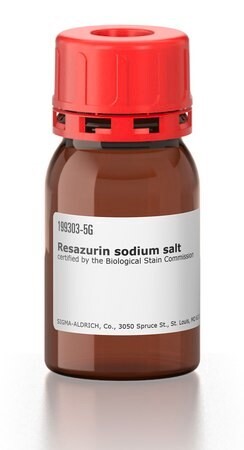
Resazurin Sodium Salt (CAS Number: 62758-13-8), systematically known as 7-Hydroxy-3H-phenoxazin-3-one-10-oxide sodium salt, is a reliable, non-destructive oxidation-reduction (redox) indicator widely used in cell biology, pharmacology, and microbiology. It serves as a gold-standard reagent for assessing cell viability, cytotoxicity, and proliferation kinetics across various mammalian, bacterial, and fungal cell models.
Owing to its high sensitivity, water solubility, and non-toxic profile at standard working concentrations, Resazurin enables real-time, continuous monitoring of cellular metabolic health without compromising cell integrity.
| Parameter | Specification / Value |
|---|---|
| Product Name | Resazurin Sodium Salt |
| IUPAC / Systematic Name | 7-Hydroxy-3H-phenoxazin-3-one-10-oxide sodium salt |
| CAS Registry Number | 62758-13-8 |
| Molecular Formula | C12H6NNaO4C_{12}H_6NNaO_4C12H6NNaO4 |
| Empirical Formula (Hill Notation) | C12H6NNaO4 |
| Molecular Weight | 251.17 g/mol |
| EC / EINECS Number | 263-718-5 |
| MDL Number | MFCD00005036 |
| Beilstein / REAXYS ID | 3794971 |
| PubChem Substance ID | 24851905 |
| NACRES Code | NA.47 |
| Physical Appearance | Dark crystalline powder (dark green, brown, or purple) |
| Solubility | Readily soluble in water, PBS, and polar solvents |
| Assay Modality | Dual-mode: Fluorometric and Colorimetric |
The assay mechanism relies on the intrinsic metabolic capability of viable cells to reduce the non-fluorescent dye into a highly fluorescent product via mitochondrial and cytosolic dehydrogenases coupled with electron carriers (NADHNADHNADH and NADPHNADPHNADPH):
Oxidized State: In cell culture medium, Resazurin remains in a stable, dark blue, weakly fluorescent state.
content_copy
| Comparative Feature | Resazurin Assay | MTT Assay | Trypan Blue Exclusion |
|---|---|---|---|
| Detection Principle | Mitochondrial / Cytosolic Redox activity | Mitochondrial Dehydrogenase activity | Cell membrane integrity |
| Readout Format | Fluorometric + Colorimetric | Absorbance only | Manual / Automated optical counting |
| Cytotoxicity | Non-toxic / Non-destructive | Cytotoxic (forms insoluble formazan) | Cytotoxic over prolonged exposure |
| Solubilization Step | None (Direct homogeneous read) | Requires organic solvents (e.g., DMSO) | None |
| Multiplexing Capability | High (compatible with downstream assays) | Poor (leads to cell lysis) | Limited |
| Sensitivity | High (detects low cell densities) | Moderate | Low |
Enables quantitative evaluation of anticancer drug candidates, novel chemical entities, engineered nanomaterials, and environmental toxicants across diverse cell lines with minimal operational steps.
Facilitates continuous, longitudinal tracking of cell division dynamics, stem cell differentiation, and growth factor responses over extended culture intervals.
Provides rapid, clear endpoint determinations for Minimum Inhibitory Concentration (MIC) assays against Gram-positive, Gram-negative bacteria, yeasts, and filamentous fungi in 96-well microplate formats.
Due70-600 nm Emission: ~585-590 nm (Ex: 530-560 nm)
| # | Feature Title | Value |
|---|
| Title / Version Code | Description |
|---|
| Title Accessories | Accessory Code |
|---|